
Perseus Monitoring 150





€698.90
The Complete 1U 19" Solution for Rack Monitoring
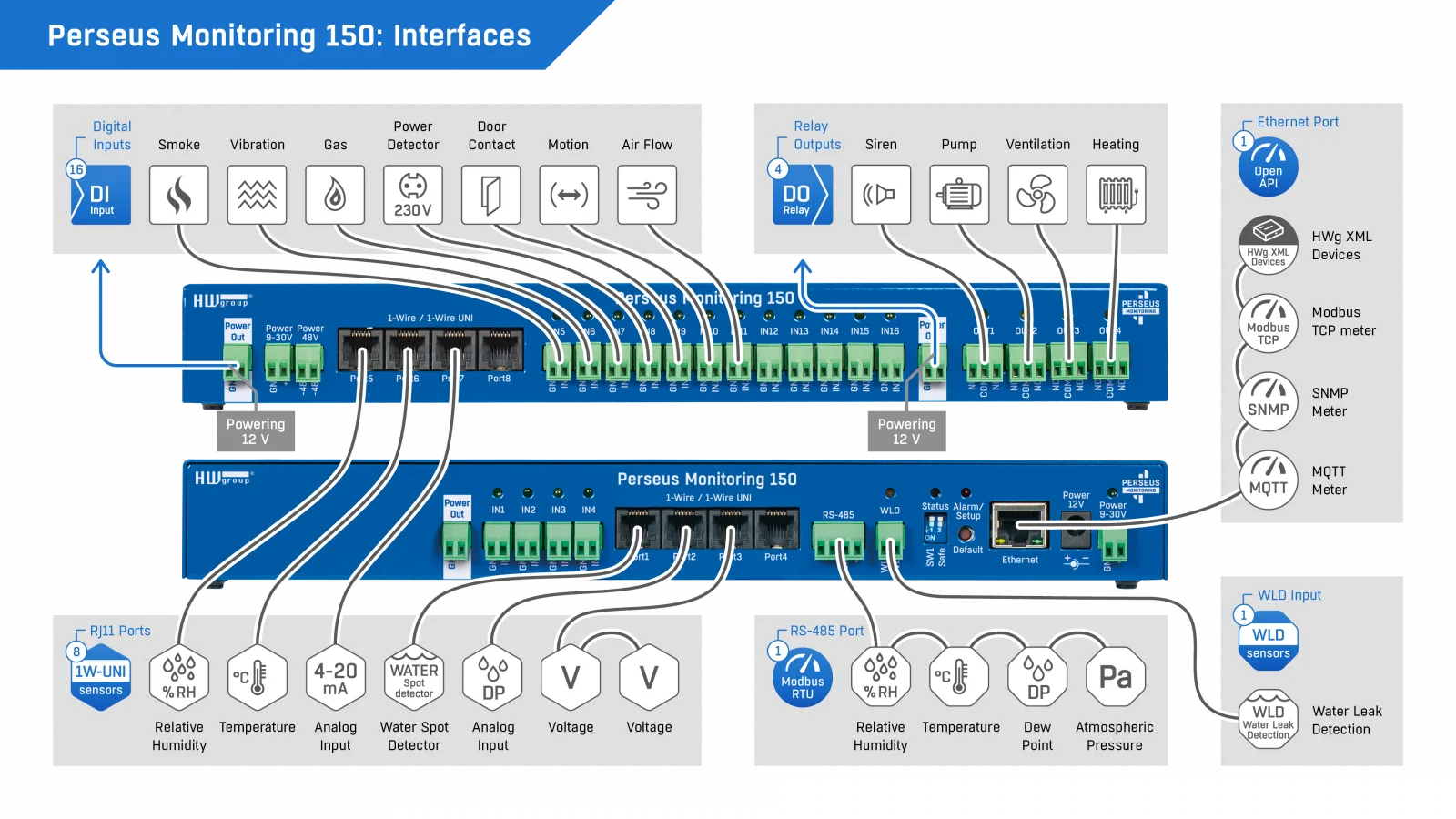
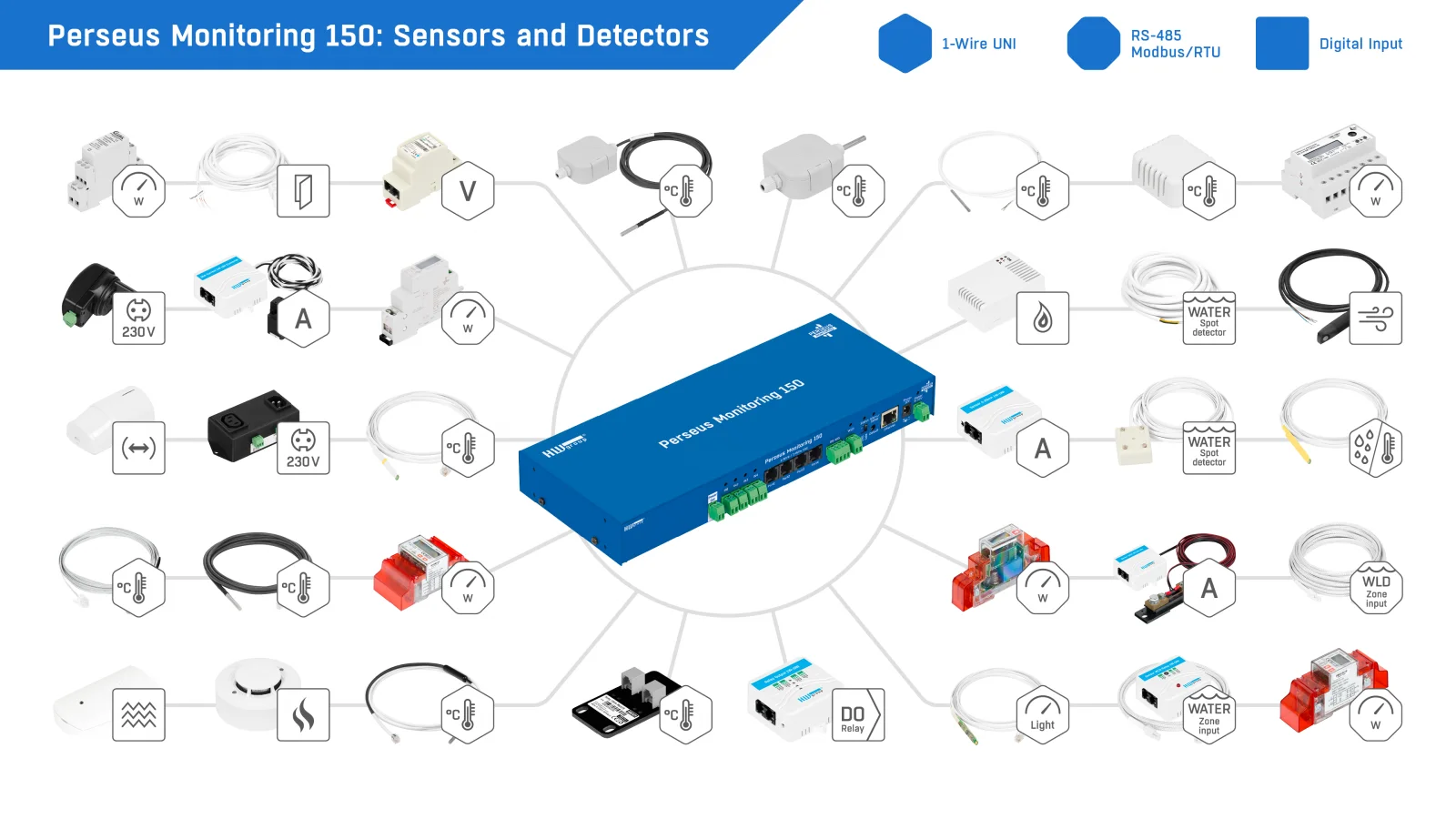
The HW group Perseus Monitoring 150 is a comprehensive 1U solution for a 19" rack monitoring system, designed for data centers, AV installations, telecommunications facilities and other technical environments. The device connects external physical sensors (°C, %RH, A, V, …), digital inputs (DI), one WLD zone (water leak detection), relay outputs (DO) and third-party meters via LAN or RS-485 (Modbus/RTU).
All sensor data from these sources is analyzed and processed by the Perseus device – with a capacity of up to 100 meters or 1,000 values (variables). A unique feature of the Perseus family is the ability to integrate further HWg devices connected via LAN as external meters. Local conditions, Lua scripting and a calendar support the evaluation of the measured data.
Sensors, Detectors and Other Network Devices in a 1U System
The Perseus Monitoring 150 combines classic sensor connections with the evaluation of other devices on the same LAN – flexibly powered via 9-30V, -48V or PoE.
8x RJ11 (1-Wire UNI)
Up to two 1-Wire UNI sensors from HW group per port, e.g. for temperature, humidity, voltage or current.
RS-485 (Modbus/RTU)
4-pin terminal block with 12V for connecting Modbus/RTU-capable third-party devices such as energy meters, UPS or GenSet.
WLD Water Leak Detection
1 zone for an external water sensor cable with a total length of up to 185 m.
16x DI / 4x DO
Sixteen digital inputs for dry contacts and four relay outputs for controlling e.g. ventilation or doors.
PoE / -48V / 9-30V
Flexible power supply via Power over Ethernet, Telco standard -48V DC or classic 9-30V DC.
Meters API
Additionally reads sensor data from other HWg and third-party devices on the same LAN (SNMP, Modbus/TCP, MQTT, HWg XML).
Individually Selectable: Base Unit or Complete Starter Set
The Perseus Monitoring 150 is available either as a pure base unit, as a temperature monitoring starter set or as a complete rack monitoring starter set. The desired variant is selected directly above the shopping cart.
Please note: The base unit "Perseus Monitoring 150" includes neither a power supply nor a 19" mounting set. The "Tset" and "Rack Tset" sets include additional accessories. The variant must be selected before adding to the shopping cart.
Perseus Monitoring 150
Perseus 150 unit as a rack monitoring system: 16x DI, 4x DO (relays), 8x RJ11 (8x60 m, 1 port = 1 sensor), 1x WLD zone, RS485 Modbus-RTU, Meters API. LAN with PoE or external 48V DC. Power supply or 19" mounting set are not included.
Perseus Monitoring 150 Tset
Perseus 150 temperature monitoring starter set. Includes: Perseus Monitoring 150 as above, universal power supply 12V/1.5A and a Temp-1Wire-3m-IP67 temperature sensor.
Perseus Monitoring 150 Rack Tset
Perseus 150 rack monitoring starter set. Includes: Perseus Monitoring 150 as above, RM2 brackets 19", WLD sensor cable A (2+2 m), Temp-1Wire Rack19 temperature sensor, door contact MK4 and a universal power supply 12V/1.5A.
How the Perseus Monitoring 150 Is Built
The robust metal housing is designed as a 1U 19" rack device measuring approx. 35 x 111 x 290 mm (W x H x D), with protection class IP40 and designed for operating temperatures from -30°C to 85°C.
1U 19" Metal Housing
Robust metal housing in 1U format for direct installation in a 19" rack, optionally with the optional RM2 mounting brackets (included in the Rack Tset, otherwise available separately).
Ethernet Port with Web Server and PoE
One RJ45 Ethernet port (100BASE-T) connects the device to the network and can simultaneously power it via Power over Ethernet; an integrated web server enables configuration directly via the browser.
Sensor Connections
Eight RJ11 ports for 1-Wire/1-Wire UNI sensors and a 4-pin RS-485 terminal block (including 12V) for Modbus/RTU devices.
WLD, DI and DO Terminals
One WLD zone connection for the water leak sensor cable (A/B), sixteen terminals for digital dry-contact inputs and four relay outputs (up to 50V/1000mA) for controlling external actuators.
Flexible Power Supply
The Perseus 150 is powered either via a barrel connector (2.1/5.5 mm) or a terminal block with 9–30 V DC, via a terminal block with Telco standard -48V DC, or directly via PoE through the Ethernet port (power consumption depending on supply type approx. 250–500 mA).
Status Indicators
LEDs on the front of the device indicate, among other things, status, alarm and WLD state.
Evaluate Sensor Data from Other LAN Devices as Well
The Meters API is a unique feature of the Perseus product line: the device additionally reads sensor values from external LAN devices and includes them in analyses and alarms.
- Readable protocols: HWg XML, Modbus/TCP, SNMP, MQTT
- Examples of supported third-party devices: STE2 LITE, Poseidon2 4002, Damocles2 1208, NETIO PowerPDU 8QS, SNMP-capable UPS systems
- Comparison of multiple sources possible, e.g. own 1-Wire temperature sensor vs. external thermometer vs. UPS temperature probe
- Alarm can be triggered as soon as at least 2 of several sources exceed a critical value
In addition, the Perseus Monitoring 150 supports integration into building automation systems via BACnet/TCP as well as IPv6 for modern, future-proof network environments.
Multi-Level Notification for Critical Events
The Perseus Monitoring 150 offers both local and network-based alarm options.
Local Alarms
Switching of the relay outputs (DO) based on sensor data, e.g. to activate ventilation or sirens.
Standalone Device Alarms
SNMP trap and e-mail directly from the device; SMS and call alarms can be realized via an external SMS gateway (e.g. SMS-GW3).
Portal Alarms (SensDesk)
Additionally e-mail, SMS, voice calls, device failure alert (Device Invalid Alert), alarm escalation and group alarms.
Advanced Conditions
Alarms can be configured, for example, so that they only take effect when 2 of 5 sensors exceed a threshold or are unreachable.
Lua Scripting, Conditions and Schedules
For individual evaluation logic, the Perseus Monitoring 150 comes with several tools.
- Local, user-defined scripts in Lua
- Variables with multiple conditions and actions
- Calendar- or period-based scheduler
- Template repository for third-party sensors
- Virtual sensors as well as unit conversion and calibration offset
- Integrated logger with 32 MB memory
Secure Authentication and Encryption
- RADIUS authentication according to IEEE 802.1X
- HTTPS with customer certificate
- Admin and user accounts with separate access rights
- IPv6 support as well as SNMP v1 and v3 (including SNMP traps)
From Free Cloud Access to Your Own Portal Instance
The Perseus Monitoring 150 can optionally be connected to the SensDesk portal and thereby expanded with central evaluation and management functions.
HWg-cloud.com
Free portal service with e-mail alarms, device failure alert and a value graph with short history.
SensDesk.com / Portal Provider
Paid portals with e-mail, SMS and voice call alarms, virtual sensors, multi-graphs over several years, PDF reports and multi-user accounts.
Portal On-Premise
Standalone SensDesk installation on your own server for companies with special data protection requirements.
HWg Monitor App
Mobile app for iOS and Android, shows all sensor values at a glance – also usable as a wall display in the technical room.
Commissioning in a Few Steps
Setting up the Perseus Monitoring 150 is done entirely via the web browser.
- Mount the device in a 19" rack (RM2 brackets included in the Rack Tset) or place it freestanding
- Select power supply: 9–30 V DC, -48V DC or PoE via the Ethernet port (power supply included depending on the variant)
- Connect the device to the network via Ethernet cable
- Open the device’s IP address in the browser (initial search e.g. possible with HWg-Config)
- Connect 1-Wire UNI sensors to the RJ11 ports or Modbus/RTU devices to the RS-485 terminal block
- Optional: wire the WLD sensor cable, dry contacts and relay outputs
- Optional: configure alarm rules, Lua scripts or the connection to SensDesk/HWg-cloud.com
Why the Perseus Monitoring 150 Is the Right Choice
1U Rack Format
Space-saving installation directly in a 19" rack, ideal for data centers.
Extensive I/Os
8x RJ11, RS-485, WLD, 16x DI, 4x DO in one device.
Flexible Power Supply
PoE, -48V Telco standard or classic 9-30V DC.
Meters API
Additional evaluation of sensor data from other LAN devices.
Open Standards
SNMP, Modbus/TCP, MQTT, XML and BACnet/TCP.
24-Month Warranty
According to the manufacturer with 24 months warranty from the date of purchase.
Practical Application Examples
- Data center / single-rack monitoring
- Remote monitoring of technical rooms
- Telecommunications installations
- Remote infrastructure monitoring
- Industrial automation
- Data concentrator for all local sensors and meters at one site
Practical example: In a data center, up to four 1-Wire UNI temperature sensors (up to 60 m) are connected directly to the Perseus Monitoring 150 to monitor the temperature in server racks. In addition, the device reads the battery status of an SNMP-capable UPS via the Meters API. An alarm is triggered as soon as 2 of 5 sensors exceed a threshold or are unreachable, and is sent to the responsible recipients according to an internal schedule.
Frequently Asked Questions
What is the HW group Perseus Monitoring 150 and what is it used for?
The Perseus Monitoring 150 is a 1U 19" rack solution for remote monitoring that combines external sensors, detectors and data from other LAN devices. It is particularly suitable for data centers, server rooms, telecommunications facilities and rack monitoring in general.
What is the difference between the base unit and the starter sets?
The base unit "Perseus Monitoring 150" includes neither a power supply nor a 19" mounting set. The "Tset" additionally includes a universal power supply (12V/1.5A) and a Temp-1Wire-3m-IP67 temperature sensor. The "Rack Tset" additionally includes RM2 brackets 19", a WLD sensor cable A (2+2 m), a Temp-1Wire Rack19 sensor, a door contact MK4 and a universal power supply 12V/1.5A. The variant is selected above the shopping cart.
How is the Perseus Monitoring 150 powered?
The device can be operated either via 9–30 V DC (barrel connector or terminal block), via a terminal block with Telco standard -48V DC, or directly via Power over Ethernet (PoE) through the Ethernet port. A matching 12V/1.5A power supply is already included with the starter sets; for the base unit it must be obtained separately.
What exactly is the Meters API?
The Meters API is a special feature of the Perseus product line: in addition to the directly connected sensors, the device can also read values from other devices on the same LAN, for example from further HWg devices, SNMP-capable UPS systems or network PDUs, and include this data in its own analyses and alarms.
How many sensors can be connected?
Directly available are 8x RJ11 ports with up to two 1-Wire UNI sensors each as well as one RS-485 connection for Modbus/RTU devices. In total, the Perseus Monitoring 150 supports up to 100 meters or 1,000 variables according to the manufacturer, among other things through the additional integration of sensors via the Meters API.
What is the maximum length of the water leak sensor cable?
An external water sensor cable with a total length of up to 185 metres can be connected to the WLD zone connection.
Can SMS or call alarms also be sent?
The Perseus Monitoring 150 does not have its own mobile modem. SMS and call alarms are possible via an external SMS gateway (e.g. SMS-GW3) or via the SensDesk portal.
What security features does the device offer?
The Perseus Monitoring 150 supports RADIUS authentication according to IEEE 802.1X, HTTPS with customer certificate, separate admin and user accounts as well as IPv6 and SNMP v1/v3 including SNMP traps.
Questions about the Perseus Monitoring 150?
Our support team in Germany provides free advice on selection, sensors and configuration.
- Perseus Monitoring 150:
Power supply or 19" mounting kit NOT included - Perseus Monitoring 150 Tset:
INCLUDES universal power supply 12V 1.5A
Temp-1-Wire 3m IP67 temperature sensor -
Perseus Monitoring 150 Rack Tset:
RM2 brackets 19"
WLD sensor cable A - 2+2m
Temp-1-Wire Rack19 sensor
Door contact MK4
INCLUDES universal power supply 12V 1.5A.
Interfaces:
- 8× RJ11 ports for 1-Wire / 1-Wire UNI sensors
- 1× RS-485 (Modbus/RTU) – 4-pin terminal block with 12V
- 1× WLD zone for external water leak detection cable
- 4× DO (relay outputs)
- 16× DI (digital inputs, dry contact)
- Ethernet RJ45 (100BASE-T)
Meters API Support:
- HWg XML
- Modbus/TCP
- MQTT
- SNMP
Alarm Functions:
- SNMP Trap
- SMS / Calls (with external SMS gateway)
- Output switching
Open API:
- SNMP
- XML
- Modbus/TCP
- MQTT
Security Features:
- IPv6 support
- SNMP Traps
- SNMPv3
- Radius – IEEE 802.1X
- Admin and user accounts
- HTTPS (client certificate)
Technical Specifications:
- Power supply: 9-30V (12V, 1.5A)
- PoE (Power Over Ethernet) supported
- Telco standard -48V DC
- Operating temperature: -30°C to 85°C (-22°F to 185°F)
- Enclosure: Metal, 1U / 19" rack, 35 × 111 × 290 mm
- Warranty: 24 months
Capacity Limits:
- Limit of 100 sensors / 1000 values (variables)
RS-485 Modbus/RTU Features:
- Support for Modbus/RTU meters (R/W)
- Connection of third-party devices
- Compatible with power meters, UPS, or GenSet from other manufacturers
Sensors and Cables:
- 1× WLD zone for external water leak detection cable
- Support for 1W-UNI sensors from HW group
- Connection for physical sensors (°C, %RH, A, V, ...)
- 16× digital inputs for detectors (dry contact)
Additional Features:
- Local Lua scripts
- Calendar-based scheduler
- Template repository for third-party sensors
- Variables with multiple conditions and actions
- Unit conversion
- 4× DO (relay outputs) controllable by local alarms, conditions, and Lua scripts
Typical Applications:
- Data center / single rack monitoring
- Remote monitoring of technical rooms
- Telecommunications installations
- Remote infrastructure monitoring
- Industrial automation
Manufacturer information:
HW group s. r. o.
Rumunská 26
Prague, 120 00
Czech Republic
Phone: +420 222 511 918
Email: sales@hwg.cz
Responsible person:
Didactum® Security GmbH
Im Mühlenfeld 4
48163 Münster
Deutschland
Fon:
(+49) 250 19 71 63 54 / (+49) 171 33 11 577
Email: info@didactum-security.de
