

AKCP AQS Air Quality in the Data Center
AKCP Air Quality Sensor (AQS): Enhanced Protection for Data Centers through Intelligent Air Quality Monitoring
In modern data centers and critical infrastructures, great importance is attached to temperature monitoring, power supply, and access control. However, one crucial factor is often underestimated: air quality. With the new Air Quality Sensor (AQS), AKCP is expanding its portfolio with an all-in-one solution for monitoring particulate matter, gases, temperature, and humidity. The goal is to control a frequently invisible source of danger and thus sustainably increase operational reliability.
Why air quality is crucial in the data center
In many IT environments, temperature sensors show that sufficiently cool air is flowing into a server rack. Nevertheless, overheating problems still occur time and again. The cause is often not the cooling system itself, but the air quality. Dust particles accumulate on heat sinks, fans, and electronic components. These deposits act like an insulating layer and prevent efficient heat transfer.
The result:
The cooling system has to work harder, energy consumption increases, and individual servers may overheat despite an apparently optimal air supply. This “invisible cooling crisis” cannot be detected with conventional temperature sensors alone. This is where the AKCP Air Quality Sensor comes in.
The AKCP Air Quality Sensor (AQS) at a glance
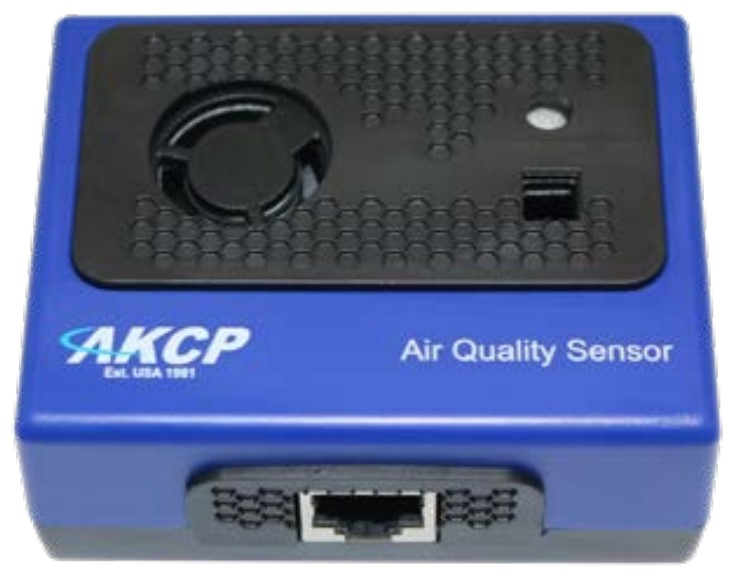
The Air Quality Sensor (AQS) is a compact and highly precise measuring device for monitoring air quality in data centers, technical rooms, and other critical facilities. It not only measures particulate matter concentrations, but also records gas values as well as ambient parameters such as temperature and humidity.
This provides a holistic data basis for identifying the causes of overheating, corrosion, or creeping system failures at an early stage.
Monitoring particulate matter – Particulate Matter (PM)
The AQS measures different particulate matter sizes:
PM1.0
PM2.5
PM4.0
PM10
The mass concentration range is between 0 and 1,000 µg/m³ with an accuracy of ±10% or ±10 µg/m³ (whichever is greater). The detected particle size range extends from 3.0 µm to 10 µm. Thanks to the dust-resistant Sheath Flow Technology, the sensor achieves a service life of more than 10 years.
High particulate matter levels indicate a contamination of the room air. In server environments, this usually means that particles are depositing on electronic components and impairing heat dissipation.
CO2, VOC, and NOx monitoring
In addition to particulate matter, the AQS also detects critical gas parameters:
CO2 measurement: 0 to 40,000 ppm
Accuracy: ±(50 ppm + 2.5% of reading)
VOC index: 1 to 500 (relative index)
NOx index: 1 to 500 (relative index)
An increased concentration of VOC (Volatile Organic Compounds) or nitrogen oxides (NOx) can, in combination with incorrect humidity, create a “perfect storm” scenario for corrosion. Metallic contacts, conductor tracks, and plug connections are particularly at risk. In the long term, this can lead to contact problems and failures.
Temperature and humidity measurement
The AQS also integrates classic environmental monitoring:
Temperature range: −10°C to +50°C
Accuracy: ±0.45°C (typical)
Resolution: 0.1°C
Humidity range: 0% to 90% RH (non-condensing)
Accuracy: ±4.5% RH
Resolution: 1% RH
The combination of these parameters enables a detailed analysis of the environmental conditions and supports facility managers and IT administrators in root cause analysis.
Compact design and easy integration
The Air Quality Sensor is housed in a compact enclosure:
Width: approx. 77.35 mm
Depth: approx. 61.90 mm
Height: approx. 32.64 mm
With a maximum cable length of 10 m, the AQS can be flexibly integrated into existing monitoring infrastructures. Installation is straightforward and suitable for both new and existing data centers.
Areas of application
Data centers
Server rooms
Industrial plants
Telecommunications sites
Critical infrastructure
In all of the above environments, the sensor helps to prevent operational downtime and to optimize maintenance intervals on a data-driven basis.
Benefits for operators of critical infrastructures
Early detection of dust-related issues
Optimization of cooling performance
Reduction of energy consumption
Protection against corrosion
Long-term safeguarding of uptime
Summary
With the new Air Quality Sensor (AQS), AKCP is expanding its portfolio with a powerful solution for monitoring air quality in data centers. By combining particulate matter measurement, gas monitoring, and classic environmental parameters, operators obtain a comprehensive picture of their infrastructure conditions. This makes it possible to detect hidden risks at an early stage and take proactive countermeasures.
Additional technical information (excerpt from product datasheet)
The following technical data are taken from the official product catalog:
The sensor supports monitoring of PM1.0, PM2.5, PM4.0, and PM10 with a mass concentration range from 0 to 1,000 µg/m³.
CO2 measurement is performed up to 40,000 ppm.
VOC and NOx values are output as an index from 1 to 500.
Temperature is measured between −10°C and +50°C, humidity between 0% and 90% RH.
Thanks to Sheath Flow Technology, a service life of more than 10 years is possible.

Was this post helpful?
Thank you for your feedback!