


Didactum Knowledge Base · Didactum CAN Devices
DIN Sensor Expansion Unit
Overview of the device and technical specifications of the Didactum DIN Sensor Expansion Unit for 8 sensors – the DIN rail CAN bus expansion module with 8 additional analog sensor ports for all Didactum monitoring systems with a CAN bus port.
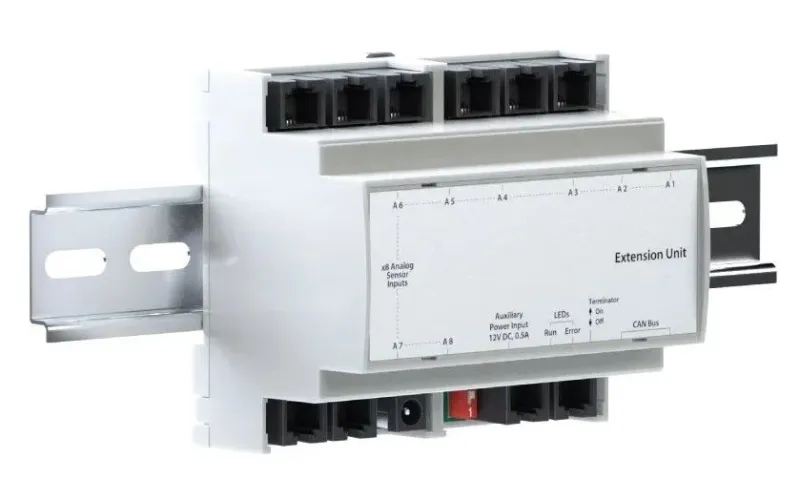

What sets the DIN sensor expansion unit apart
A modular, chainable CAN bus expansion for space-saving integration of analog sensors directly in the control cabinet.
+8 sensor ports
Each unit instantly expands the system with 8 additional analog sensor connections.
Built for the DIN rail
Compact housing for direct, space-saving mounting in control cabinets and distribution boards.
Automatic detection
Connected sensors are automatically detected and integrated into the system once connected.
Daisy-chain capable
Up to 24 units per CAN bus line – equivalent to up to 192 additional sensor ports.
Long range
Up to 225 m of CAN bus length; sensor cables can be run 50–150 m depending on sensor type.
Flexible mounting
In addition to classic DIN mounting, wall or 19″ rack installation is also possible.
Compatible with all CAN-enabled systems
Can be used with any Didactum monitoring system with a CAN bus port, e.g. 50T, 100T, 300T, 500T, and 550T.
Centralized management
All sensors – whether on the main device or on the expansion unit – are configured centrally via the web interface.
Typical application scenarios
The DIN sensor expansion unit is suited to demanding industrial environments where sensors need to be connected directly in the control cabinet.
- Expanding a Didactum monitoring system with additional temperature and humidity sensors
- Connecting additional smoke detectors, water leak sensors, and door contact sensors in control cabinets
- Modular sensor expansion in production facilities and power supply systems
- Retrofitting existing monitoring installations without replacing the base unit
- Space-saving installation in distribution cabinets of critical infrastructure
- Building large, modular sensor networks via daisy chaining over the CAN bus
- Remote monitoring of industrial facilities with automation of relays and alarms
- Centralized management of distributed sensor points through a single monitoring system
Connection diagram
Overview of all ports, LEDs, and switches of the DIN sensor expansion unit.
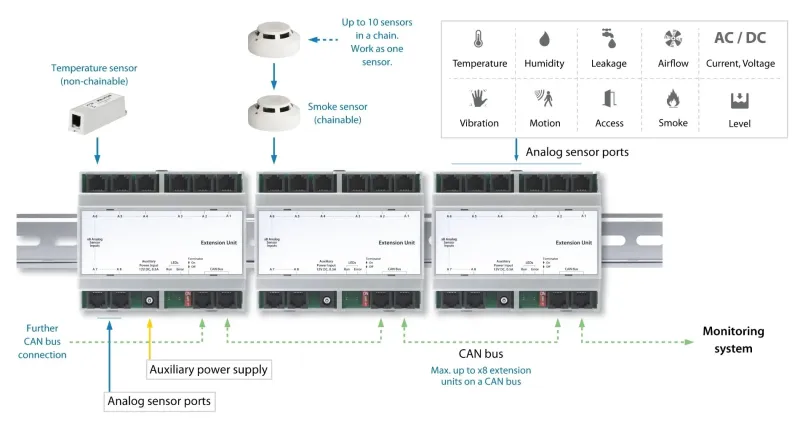
Connection diagram of the DIN sensor expansion unit for 8 sensors.
Scalability in detail
Using proven CAN bus technology, multiple DIN sensor expansion units as well as other CAN-enabled devices and sensors can be combined in a single chain.
Provided no other CAN devices are installed in the same chain, up to 24 DIN sensor expansion units can be operated on a single CAN bus line – equivalent to up to 192 additional analog sensor ports on just one monitoring unit. In general, 10–32 CAN devices can be combined on a single CAN bus line, depending on line length, signal quality, and power supply.
Note: An additional CAN-12V-1A power supply unit is only required if the number of CAN devices in the CAN bus chain exceeds 12.
Flexible power supply
Operating the DIN sensor expansion unit generally requires an external 12V DC power supply, especially when multiple expansion modules or many sensors are connected.
With short cable runs and only one connected expansion unit, operation is also possible without a separate power supply. The power supply is designed to ensure stable operation at all times, even with a modular sensor expansion involving many connected sensors.
Flexible mounting options
Thanks to its well-thought-out design, installation is highly flexible and can be adapted to different installation locations.
DIN rail mounting
Direct mounting on the DIN rail, available with either 7 mm or 15 mm mounting depth – the classic installation method for this unit.
Wall mounting
Alternative mounting on a wall or surface using the appropriate mounting accessories.
19″ rack mounting
Integration into a 19″ server rack using the matching rackmount accessories.
What's included in the scope of delivery
Please check the scope of delivery for completeness upon receipt and report any missing or damaged parts to your supplier immediately.
- DIN sensor expansion unit (8x analog)1 piece
- RJ11/RJ12 connecting cable (CAN)1 piece
- Quick start guide1 piece
Mounting accessories for wall or 19″ rack mounting, as well as an additional CAN-12V-1A power supply unit, are optional accessories and are not included in the scope of delivery.
Dimensions in detail
Technical data
Function
| Device type | CAN bus device |
|---|---|
| Function | Expands Didactum monitoring systems with 8 additional analog sensor ports per unit |
| Integration | Automatic detection and integration of all connected sensors |
Inputs/outputs & communication
| Analog sensor connections | 8 |
|---|---|
| CAN connectors | 2 × RJ11/RJ12 6P4C |
| Network interface | CAN Open |
| Daisy chain | Yes, can be combined with additional CAN bus sensors and expansions |
System expansion
| Max. units in a chain | 24, provided no other CAN devices are installed in the chain |
|---|---|
| Max. CAN devices per chain (general) | 10–32, depending on line length, signal quality, and power supply |
Power supply
| Input voltage | 12V DC |
|---|---|
| Additional power supply | CAN-12V-1A required if more than 12 CAN devices are in the chain |
| Max. bus length | 225 m |
| Max. cable length for analog sensors | 50–150 m, depending on sensor type |
Environmental conditions
| Operating temperature | -10 to +80 °C |
|---|
Mechanics & mounting
| Dimensions (W × H × D) | 129 × 28.6 × 56 mm |
|---|---|
| Weight | approx. 0.33 kg |
| Status indicators | Red (error), Green (operation) |
| TR switch | Enable when the unit is the last device in a CAN bus chain |
| Mounting options | DIN rail (7 mm or 15 mm mounting depth), wall mounting, 19″ rack mounting |
Frequently asked questions
What is the DIN sensor expansion unit and what is it needed for?
It is a DIN-rail CAN bus expansion that increases the number of analog sensors that can be connected to a Didactum monitoring system by 8 ports per unit. It is needed when the built-in sensor connections of a monitoring system are not sufficient and additional temperature, humidity, smoke, water leak, or door contact sensors need to be connected directly in the control cabinet.
How does the DIN variant differ from the standard Expansion Unit for Sensors 8x Analog?
Both units each provide 8 additional analog sensor ports via the CAN bus and share the same electronics. The DIN variant is specifically designed for direct mounting on a DIN rail (7 mm or 15 mm mounting depth) in control cabinets and is therefore slightly lighter (approx. 0.33 kg instead of 0.47 kg), but can also be mounted on a wall or in a 19″ rack if needed.
Which Didactum monitoring systems is the expansion unit compatible with?
The DIN sensor expansion unit is compatible with all Didactum monitoring systems that have a CAN bus port, including the 50T, 100T, 300T, 500T, and 550T models.
How many expansion units can I connect to a monitoring system?
Provided no other CAN devices are installed in the same chain, up to 24 DIN sensor expansion units can be operated on a single CAN bus line, which corresponds to up to 192 additional analog sensor ports. In general, 10–32 CAN devices can be combined on a single CAN bus line; the exact limit depends on line length, signal quality, and power supply.
Do I need an additional power supply for the expansion unit?
With short cable runs and only one connected expansion unit, operation is possible without a separate power supply. In all other cases, an external 12V DC power supply is required. If the number of CAN devices in the chain exceeds 12, the CAN-12V-1A power supply unit is additionally needed to stabilize the power supply.
What mounting options are available for the expansion unit?
In addition to classic DIN rail mounting (7 mm or 15 mm mounting depth), the unit can also be installed on a wall or in a 19″ server rack. The respective mounting accessories are available separately.
Questions about the DIN sensor expansion unit?
Our support team in Germany will be happy to advise you free of charge on selection, scaling, installation, and compatibility.