DC Voltage Sensor


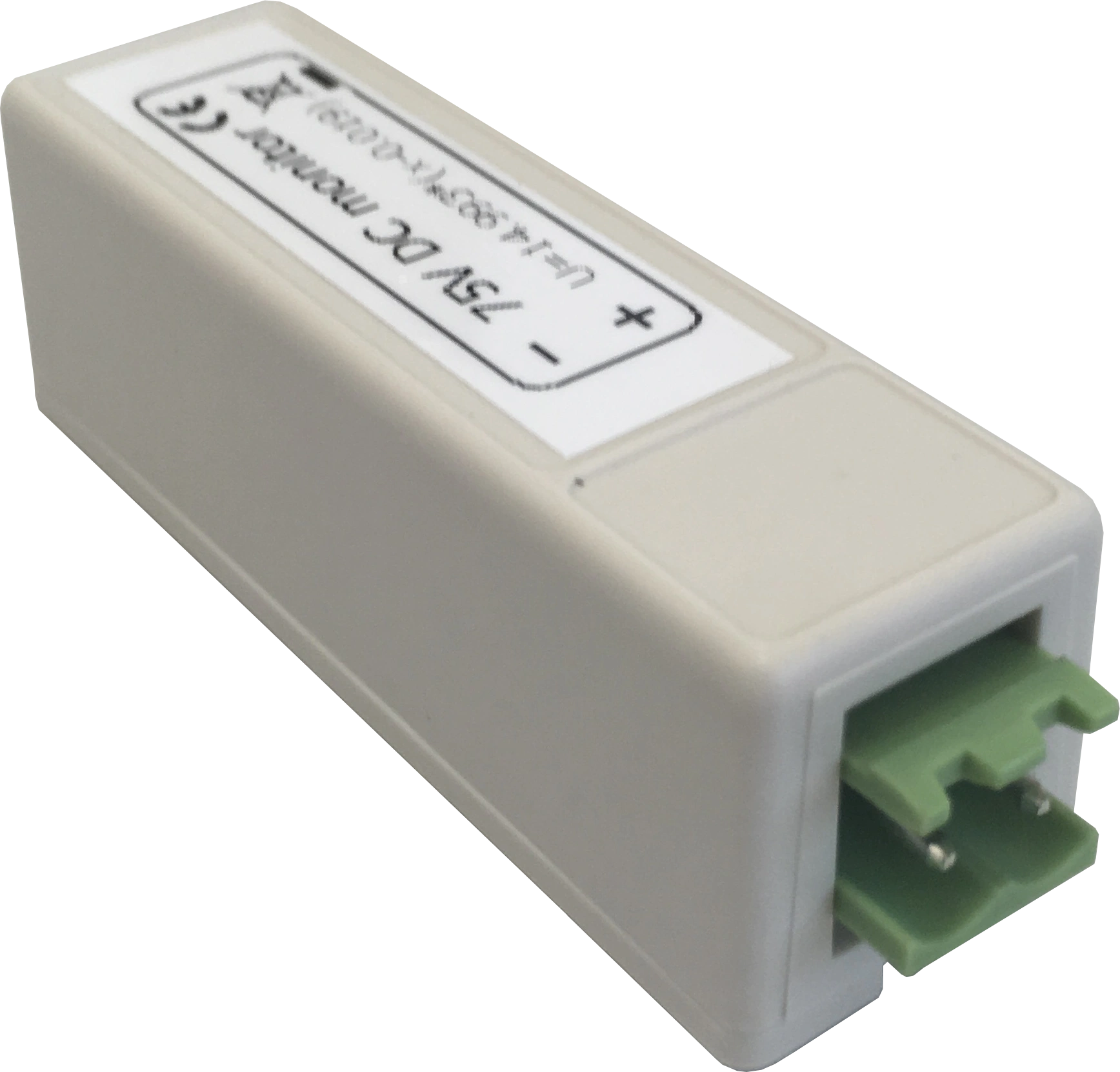


€139.00
Precise DC Voltage Monitoring in Server Rooms and Industrial Environments
The Didactum DC voltage sensor reliably and continuously monitors direct current voltages—ideal for server rooms, data centers, industrial facilities, solar systems, battery systems, and other critical business areas. It converts the measured DC voltage into a signal compatible with the Didactum Monitoring System, enabling centralized remote monitoring of DC voltage levels in real time.
Even small deviations in DC voltage can lead to data loss, hardware failures, or production downtime. The sensor is connected as a plug-and-play solution to an analog port of the monitoring system and reliably detects undervoltage and overvoltage, power failures, and mains fluctuations, allowing IT teams to respond early.
Individually configurable: Voltage range
The DC voltage sensor can be precisely tailored to the DC voltage to be monitored during the ordering process.
Please note: The desired voltage range must be actively selected above the shopping cart button under “Select voltage range” so that the correct version is delivered.
Select voltage range
0 – 15 V
For precise monitoring of lower DC voltages, e.g. in batteries, control circuits, or low-voltage systems.
0 – 75 V
For larger DC voltage systems such as 48 V telecommunications systems, UPS battery strings, or industrial DC power supplies.
Both variants operate with the same accuracy of ±1%. Choose the voltage range according to the maximum voltage expected in your application—a sensor for the lower range provides finer resolution at lower voltages, while the 75 V version is designed for higher voltages.
DC Voltage Sensor Design
The sensor consists of a compact plastic housing (60 × 18 × 18 mm, approx. 100 g) with two functional connection areas.
Input terminal
2-pin terminal block (5 mm pitch) for connecting the DC voltage source to be monitored, e.g. battery, UPS, or DC supply line.
Evaluation electronics
Converts the measured DC voltage into a digital signal compatible with the monitoring system, isolated by 1 kV between measurement and evaluation circuits.
RJ11/RJ12 output
The included 2 m shielded connection cable is used to connect the sensor to the monitoring system’s analog port or a sensor expansion unit.
The sensor is a pure signal converter and cannot operate independently—it works only in conjunction with a Didactum Monitoring System, which receives, evaluates, and uses the converted measured values for alarms and logging.
From DC voltage to monitored measured value
The DC voltage applied to the input terminal is continuously measured by the internal evaluation electronics and converted into a signal transmitted via the RJ11/RJ12 output to the monitoring system. There, the measured value can be configured in the web interface as a separate sensor with individual thresholds for undervoltage and overvoltage. If the value deviates outside the defined limits, the system automatically triggers a notification by email, SMS, SNMP trap, or relay switching.
Practical example: The sensor monitors the battery voltage of a UPS system. If the voltage drops below the defined warning value, the monitoring system immediately sends an email to the responsible technicians—long before the battery is deeply discharged and damaged.
Connection to the monitoring system
The DC voltage source to be monitored is connected to the sensor’s 2-pin input terminal. Using the included shielded 2 m RJ11/RJ12 cable, the sensor is connected to a free analog port (A1–A8) of a Didactum Monitoring System and is automatically detected there using plug-and-play (auto-sensing). The maximum cable distance between the sensor and the central unit or expansion unit is up to 50 meters.
Important note: To reliably report a power failure, the monitored line should not be protected by an uninterruptible power supply (UPS). However, the monitoring system itself should be connected to a UPS so that notifications can still be sent in the event of an alarm.
More sensors and greater range
For larger installations with multiple DC voltage sources to be monitored, the number of connectable DC voltage sensors and the maximum cable length can be increased using a Didactum sensor expansion unit (8× analog, connected to the monitoring system via CAN bus). This allows large and complex systems with many DC sources to be monitored centrally and efficiently without replacing the central unit.
Applications for the DC voltage sensor
- Server room: Monitoring DC voltage on racks, switches, storage systems, and UPS units
- Data center: Monitoring the supply voltage of critical systems for maximum operational reliability
- Industrial automation: Measuring DC voltage of automation systems and machinery
- Solar systems: Monitoring the output voltage of solar panels for optimal energy yield
- Battery systems: Monitoring charging and discharging processes within a safe voltage range
- Telecommunications infrastructure: Monitoring DC voltage on routers and switches
- UPS backup systems: Ensuring backup power supplies operate correctly when needed
- Electric vehicle charging stations: Monitoring DC voltage during the charging process
Performance data at a glance
What is included in the package
Please check the package contents upon receipt for completeness and report any missing or damaged parts to your supplier immediately.
- DC voltage sensor1 pc.
- Shielded RJ11/RJ12 connection cable, 2 m1 pc.
Why this voltage sensor is the right choice
Precise measurement
Accuracy of ±1% across the entire measuring range.
Suitable voltage range
Two variants (0–15 V, 0–75 V) for a wide range of DC applications.
Plug-and-play
Automatic detection on any analog port of the monitoring system.
Galvanically isolated
1 kV isolation voltage between measurement and evaluation circuits.
Flexible alarming
Notifications by email, SMS, SNMP trap, or relay switching.
Versatile use
For IT, industry, solar systems, battery systems, and building management.
Scalable
Expandable via additional sensor expansion units for large systems.
Made in EU
Developed and manufactured in the European Union.
Frequently asked questions
Which voltage range should I choose?
For smaller DC voltages, such as those found in batteries or low-voltage systems, the 0–15 V version is suitable. For larger systems such as 48 V telecommunications systems or UPS battery strings, choose the 0–75 V version. The decisive factor is the maximum voltage expected in your application.
Can the sensor operate independently without a monitoring system?
No. The DC voltage sensor is a pure signal converter and works only in conjunction with a Didactum Monitoring System, which receives, evaluates, and uses the measured values for alarming and logging.
How is the sensor connected?
The DC voltage source to be monitored is connected to the sensor’s 2-pin input terminal. Using the included RJ11/RJ12 cable, the sensor is connected to an analog port of the monitoring system and automatically detected there.
Why should the monitored line not be protected by a UPS?
If the monitored line itself is protected by a UPS, a failure of the main power supply would not be detected as a voltage drop. To ensure a real power failure is reported reliably, only the monitoring system itself should be connected to a UPS, not the monitored line.
How many DC voltage sensors can I connect to a monitoring system?
The number depends on the available analog ports of the monitoring system. If more connections or greater cable range are required, the number can be increased using a Didactum sensor expansion unit with additional analog ports.
How accurate is the sensor?
The sensor operates with an accuracy of ±1% across the entire measuring range and is galvanically isolated by 1 kV between the measurement and evaluation circuits.
Questions about the DC voltage sensor?
Our support team in Germany will advise you free of charge on selection, connection, and configuration.
Didactum DC Voltage Sensor
Function
- Analog plug-and-play sensor for measuring DC voltage
- Converts measured DC voltage into a compatible signal for Didactum monitoring systems
- Direct connection to analog ports of Didactum devices
- Expandable via extension unit
Measurement Range
- Measurement ranges: 75 V
- Accuracy: ±1 %
- Isolation voltage: 1 kV
- K coefficient: ~14.8 (internal processing)
Connections
- Input: 2-pin terminal (pitch 5 mm)
- Output: RJ11 / RJ12 (6P6C)
- Cable: 2 m shielded RJS3 cable included in delivery
- Maximum distance: up to 50 m to the central unit or expansion module
Electrical Data
- Power consumption: 100 mW
Environmental Conditions
- Operating temperature: -10 °C to +80 °C
- Humidity: 5 % to 95 % (non-condensing)
Mechanical Data
- Dimensions: 60 × 18 × 18 mm
- Weight: 100 g
- Mounting: desktop or wall mounting
General
- Origin: EU
- HS code: 9030 33 100
Can be used with monitoring unit:


Can be used with extension unit:


Manufacturer information:
Didactum® Security GmbH
Im Mühlenfeld 4
48163 Münster
Deutschland
Fon:
(+49) 250 19 71 63 54 / (+49) 171 33 11 577
Email: info@didactum-security.de

