
Applications
Here are some applications for the AC Connector and AC Current Transducer:
1. Power Monitoring in Data Centers:
Real-time AC current monitoring: Ensuring that server racks and cooling systems operate within permissible current limits to prevent overloads or electrical failures. Energy consumption optimization: Monitoring the energy consumption of critical infrastructures to identify areas of energy waste and improve overall efficiency.
2. Industrial Power Supply Systems:
Motor current monitoring: Measuring the current drawn by industrial motors to detect potential issues such as overcurrent, which could lead to motor failures or energy inefficiency. Equipment health monitoring: Providing insights into the condition of electrical equipment by monitoring current fluctuations, enabling predictive maintenance to avoid unplanned downtime.
3. Telecommunications Infrastructure:
Power supply monitoring: Monitoring the current supplied to telecommunications equipment to ensure that routers, switches, and backup power systems receive stable and reliable power. Backup systems: Ensuring that AC backup systems (such as generators or UPS units) function properly during power outages by monitoring the drawn current.
4. Renewable Energy Systems:
Solar inverters and wind turbines: Monitoring the alternating current generated by renewable energy sources such as solar panels or wind turbines to ensure they operate within safe limits and optimize energy production. Grid integration: Tracking the current flow from renewable systems to the main grid to ensure efficient energy distribution and compliance with grid standards.
5. HVAC Systems in Commercial Buildings:
HVAC system monitoring: Ensuring that air conditioning, heating, and ventilation systems operate efficiently by measuring the current consumption of large fans, compressors, and other components. Load management: Preventing electrical circuit overloads by monitoring the current consumption of multiple HVAC units, particularly in large commercial buildings.
6. Electric Vehicle (EV) Charging Stations:
Charging current monitoring: Tracking the alternating current supplied to electric vehicles at charging stations to ensure proper and efficient charging and prevent damage to the vehicle or charging infrastructure. Fault detection: Detecting abnormal current spikes or drops that may indicate issues in the charging system or vehicle, ensuring safety and reliability.
7. Building Automation and Management Systems (BMS):
Energy consumption tracking: Integrating current monitoring into a BMS to capture the energy consumption of various systems (lighting, HVAC, elevators) and optimize energy usage throughout the building. Load reduction: Monitoring alternating current to specifically reduce circuit loads during peak consumption periods, preventing overloads and improving energy efficiency.
These applications demonstrate the versatility of the AC Connector and AC Current Transducer across various industries, particularly where precise AC current monitoring is critical for maintaining operational safety, efficiency, and reliability.
Components
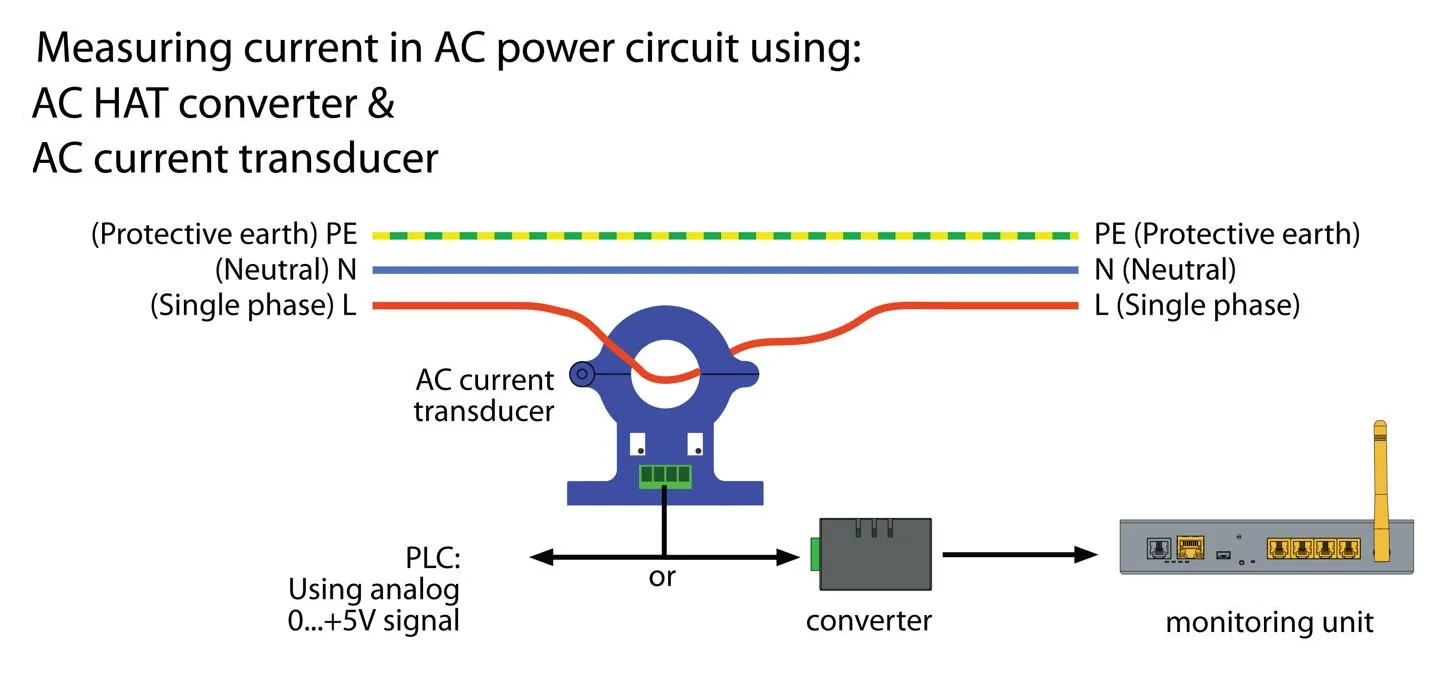
The AC Current Transducer consists of a plastic housing with an open/closed alternating current loop and four 4-pin terminal connectors.
The AC Connector current transducer is a simple plastic housing with a 4-pin input, a 12-V DC socket, and an RJ output for connection to monitoring units.


Safety Instructions
Please observe the applicable regulations for installation in the country where the current transducer is installed and operated, as well as national accident prevention regulations. Additionally, adhere to all internal company regulations, such as work, operational, and safety guidelines.
The specified technical data and limits must not be exceeded under any circumstances. This applies in particular to the specified ambient temperature range and the IP protection rating.
Installation
The transducer and the converter are installed together.
Mount the AC Current Transducer using M4 screws and M4 nuts. The distance between the mounting holes is 50 mm.
Mount the AC Connector using M4 screws and M4 nuts or with double-sided adhesive tape. The distance between the mounting holes is 60 mm.
Connect the AC Connector and the AC Current Transducer with a cable. The cable is included with the AC Connector. It has four conductors and two power connectors (4P 5.08 mm and 4P 3.81 mm) at each end.


Cable assignment

Setup
Connect the converter to the monitoring unit using an RJ11 cable, connect the 12V power supply to the 230V power source, and connect the flat ribbon cable with the green connectors to the transducer.
Two green LEDs on the sensor light up. The monitoring system automatically recognizes the current converter as a sensor.


The new sensor appears in the system's web interface. Click on the "System Tree" menu – there you will find a new sensor marked with an "fA" symbol (abbreviation for voltage function, used for sensor modules and converters).
Click on the sensor to open its properties. A modal window displaying the sensor properties will appear.
Change the sensor type by selecting "Current". Choosing any sensor type does not affect the sensor properties; it only changes the sensor icon for better clarity.
Change the sensor name, for example, to "Alternating Current".


Using an "Expression Formula"
Use the formula 20 * (x - B). "B" represents the voltage at the output of the current transducer when the current is zero.
To determine "B", measure the values of the monitoring system when there is zero current in the transducer. Typically, "B" is around 0.017 – 0.021.
Afterward, you can enter the formula 20*(x - B) and click OK.
The system is now ready to measure the current in the core of the transducer.
Save your inputs.

Finally, set the thresholds by adjusting the following limit markers: Lower Alarm, Lower Warning, Upper Warning, and Upper Alarm.
For example, the diagram above shows that the sensor is currently in the "Normal" state, as the value 20.4 lies between the "Lower Warning" and "Upper Warning" states. This is considered the normal state.
Click on "Save" (floppy disk icon at the bottom right of the "Properties" window). The page will reload, and the sensor will be updated, changing its icon type to "A" (abbreviation for "Ampere").
Example 1: Device Lifespan Prediction through Current Measurement
Device lifespan prediction is often based on the analysis of current measurement values, which reflect the operational behavior and load of the device. By continuously monitoring the current flow, abnormal currents or load fluctuations can be detected, indicating wear or impending failures.
Typically, the prediction is made by combining measured current data with wear and damage assessment models, including data-driven approaches and physical modeling. For example, motors or transformers whose current behavior is monitored can be evaluated for their remaining useful life (residual lifespan).
This enables predictive maintenance, reduces unexpected failures, and optimizes maintenance cycles. Adjusting thresholds and using analytical formulas, such as the expression described in the previous guide, support obtaining accurate measurement data for condition assessment and lifespan prediction.
The method is particularly valuable for critical systems where failure would be costly or dangerous. However, note that the accuracy of the prediction depends on the quality of the measurement data and the modeling.

Example 2: Device Blockage Notification and Detection
Device blockage notification is designed to immediately inform users and maintenance personnel when a device is blocked or malfunctioning. This enables quick responses to minimize downtime and prevent damage.
Such notification systems can be implemented via sensors or control units that monitor the operational status and automatically trigger alarms in case of blockages. Notifications are often displayed as push notifications, SMS, emails, or directly on operator terminals.
Detection typically involves evaluating mechanical or electrical signals, such as a surge in current when a drive is blocked. Modern systems offer configurable alarm triggers that automatically notify responsible personnel when thresholds are exceeded.
By integrating such notifications, maintenance can be planned more efficiently, and issues can be resolved quickly. It is important to carefully adjust the alarm criteria to avoid false alarms.

Example 3: Shutting Down Devices to Prevent Overload
Automatic shutdown mechanisms in devices are essential to prevent damage and malfunctions due to overload. They detect when the current flow exceeds a critical threshold and immediately interrupt the power supply. Such systems often rely on relays, circuit breakers, or sensors that continuously monitor the operational status.
To protect against overload, protective circuits such as circuit breakers, fuses, or electronic monitoring systems are used. In the event of an overload, caused, for example, by excessive current draw, the device automatically shuts down before overheating or damage occurs. This keeps the system operational and enhances safety.
A crucial aspect is the targeted shutdown of devices to prevent overheating and potential fires. Modern systems typically feature intelligent controls that automatically respond to critical values. These measures are indispensable in industrial environments and for sensitive equipment, significantly contributing to safety and longevity.
