
Dimensions and use:


Installation of the sensor unit:


Cut off the ledge at the bottom edge of the housing.
The ledge at the bottom edge of the housing is used for mounting inside IT racks.
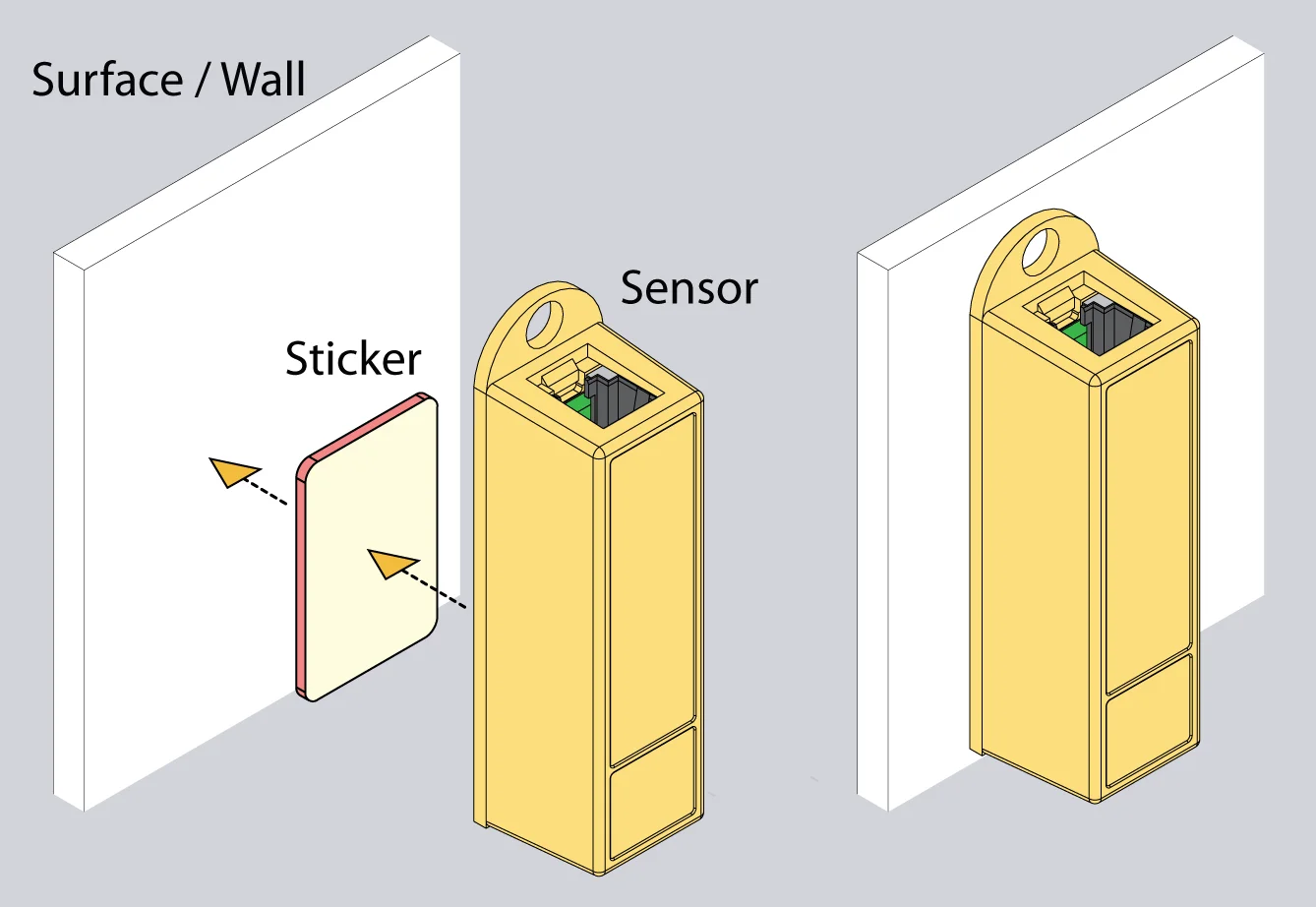
The sensor can be installed using a screw or an adhesive pad.
Installing the sensor:


The detector can be installed in different ways depending on its purpose and the surface.
See the following options:
A: For non-conductive surfaces.
B: For conductive surfaces.
C: For liquid level detection.
D: For installation on vertical surfaces for level detection.
The detector can be mounted on a surface using a screw or an adhesive pad. The detector has a hole in the middle to accommodate a screw.
Technical Data – Main Sensor Module:
- Description: The sensor has two RJ connectors. RJ 6P4C connects the sensor to the analog port of the Didactum monitoring system. RJ 4P2C connects the leak detector to two poles.
- Sensor Type: Analog
- Dimensions: 60×18×18 mm
- Weight: 60 g
- Input: 2-wire (SLD / Spot Leak Detector)
- Output: 1× RJ11 / RJ12, 6P4C
- Detection Principle: Capacitive
- Operating Temperature: -10 °C to +80 °C
- Operating Humidity: 5% to 95% (non-condensing)
- Mounting: Mounting bracket included
- Power Consumption: 60 mW
- Maximum Distance: 100 m from the monitoring unit or the Analog Sensor Extension Unit
- Response Time: 15 seconds
- Recovery Time: Depends on how quickly the sensor dries
Technical Data – Sensor Module:
- The detector is used in combination with the main module for detecting conductive liquids in tanks, pits, basements, etc. The sensor features two stainless steel poles. The detector housing is made of plastic and encapsulated for conductive liquids. The sensor can be connected to potential-free (dry contact) inputs, e.g., of an alarm system.
- Detectable Liquids: Pure, contaminated, and distilled water; acids; alkalis; alcohols; and other electrically conductive liquids
- Dimensions: 30 × 20 × 8 mm
- Cable Length: 1 m
- Weight: 21 g (including cable)
- Operating Humidity: 20% to 100% RH
- Operating Temperature: -10 °C to +50 °C
- Outputs: Two-wire, RJ 4P2C connector
- Output Type: NO (normally open)
- Special Features: Measuring electrodes resistant to chlorinated and salt water (stainless steel AISI 316 / V4A)
Connection diagram:

The end poles of the sensor must not touch any conductive surface.
Connect the water sensor to the monitoring unit at any available analog port. The connection is plug-and-play. Use an RJ11/12 6p4c to RJ11/12 6p4c cable for this purpose.
Then connect the sensor module to the main module.
Frequently Asked Questions (FAQ)
Troubleshooting
Below you will find an overview of possible issues, their causes, and recommended solutions. If the problem persists, please contact our technical support team.
Problem: The sensor is not displayed in the Didactum monitoring interface.
Possible Cause: Communication lines are faulty or not connected correctly.
Solution: Check the 6P4C RJ11 communication cable and ensure that all connections are properly seated.
Problem: The sensor is not displayed in the Didactum monitoring interface.
Possible Cause: The communication cable is plugged into the wrong port.
Solution: Insert the 6P4C RJ11 communication cable into the analog port of the Didactum monitoring system.
Problem: Can I connect the water sensor to the potential-free contact inputs of a Didactum monitoring system?
Answer: No, this is not possible. The electrical resistance is too high, which would result in unreliable sensor functionality.