


Didactum Monitoring Systems
Connecting Analog Sensors
Complete guide to connecting analog Didactum sensors: water detection chain, spot water sensor, BMS water sensor, AC voltage sensor, dust particle sensor, and DC voltage sensor.
Didactum Sensor for Water Detection Chain & Didactum Water Chain (WLC)
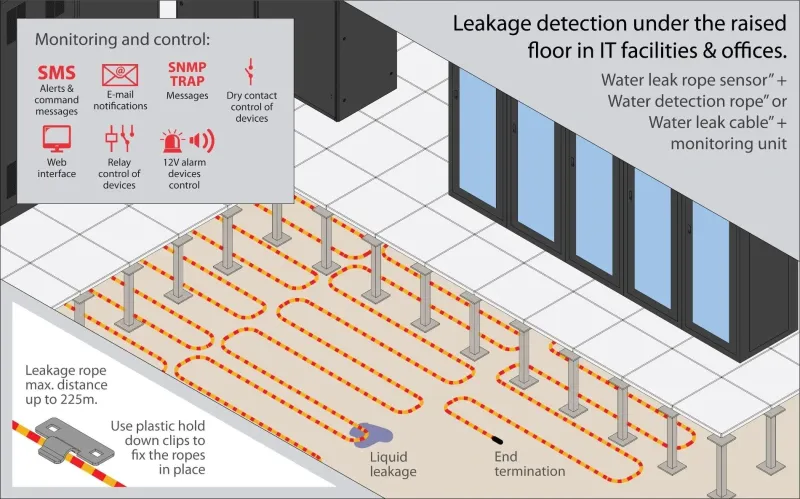
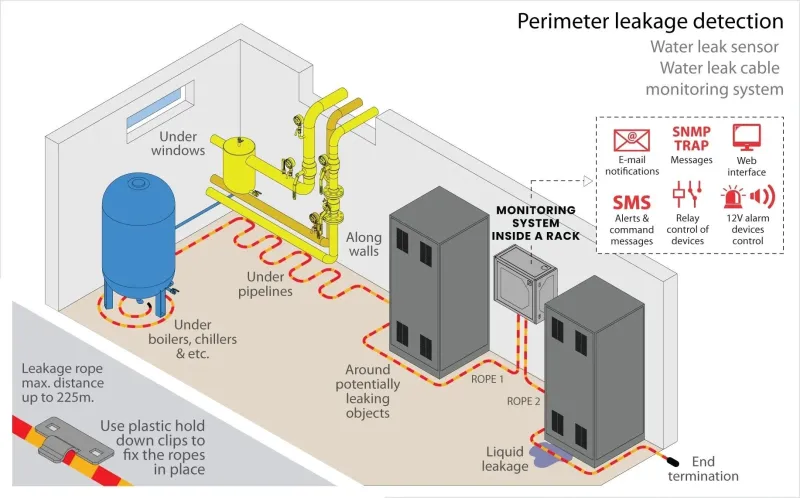
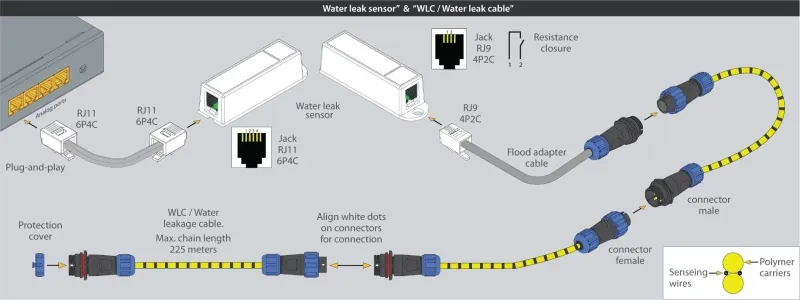
▼The Didactum Sensor for Water Detection Chain detects water leaks by measuring a drop in resistance along the connected Didactum Water Chain (WLC). The water chain is ordered separately and is available in various lengths. It can seamlessly cover the entire perimeter of a room – e.g. under raised floors in data centers or along pipelines.
The sensor is connected to any analog port (A1…A8) of the Didactum monitoring unit and enables real-time detection and alerting in the event of water ingress. For larger installations, the number of sensors and the total length can be expanded using the sensor expansion unit.
 🔍 Enlarge
| Model | Cable Length |
|---|---|
| WLC3 | 3 m |
| WLC6 | 6 m |
| WLC10 | 10 m |
| WLC15 | 15 m |
| WLC25 | 25 m |
 🔍 Enlarge
 🔍 Enlarge
 🔍 Enlarge
• The chain must not touch itself – always lay it out straight.
• Do not bend or compress it too much – the two sensing wires must not make contact.
• Only lay it on very smooth, non-conductive surfaces – no metal grids.
• The cable can be shortened; the ends must be insulated and must not touch each other. Do not form loops.
 🔍 Enlarge
- Connect the water chain to the sensor and plug the sensor into a free analog port (A1…A8). Make sure the chain is laid out straight and does not touch anything conductive. In the web interface, the sensor will show the status “Normal”.
- Slightly dampen a cloth and hold it against both yellow sensing wires of the water chain – this creates a short circuit. The sensor switches to “Alarm” status.
- Carefully dry the chain with a dry cloth. The sensor returns to the normal state.
| Problem | Cause | Solution |
|---|---|---|
| Sensor does not appear in the system | RJ11 cable connected incorrectly | Check the 6P4C RJ11 cable and plug it into the analog port. |
| Sensor permanently in alarm | Chain touches itself or lies on a conductive surface | Lay the chain out straight, avoid kinks and conductive surfaces. |
| Sensor permanently in alarm | Cable damaged | Check continuity with a multimeter: A-A and B-B must show continuity, A-B must show no continuity. |
| Readings inaccurate | Incorrect f(x) formula configured | Check the sensor configuration in the web interface. |
Didactum Water Sensor (Spot Leak Sensor)
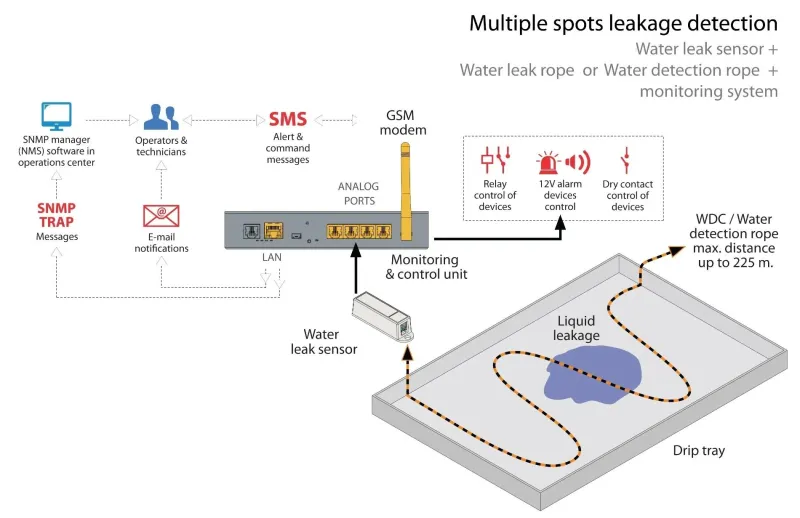
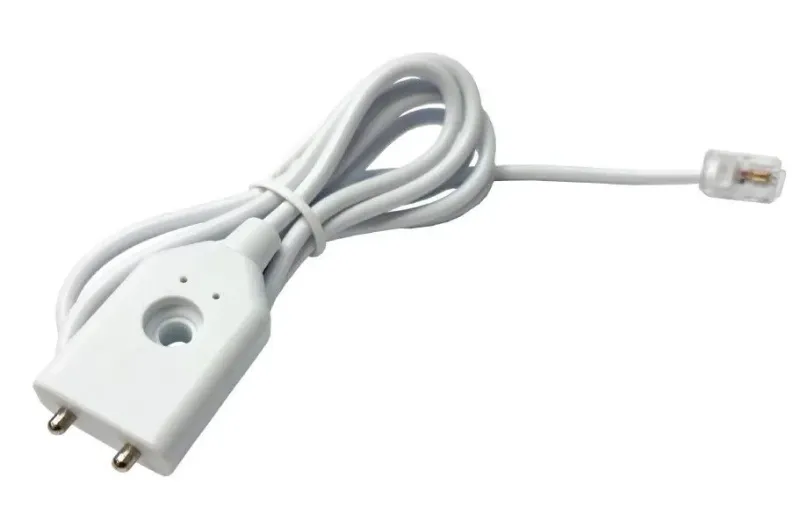
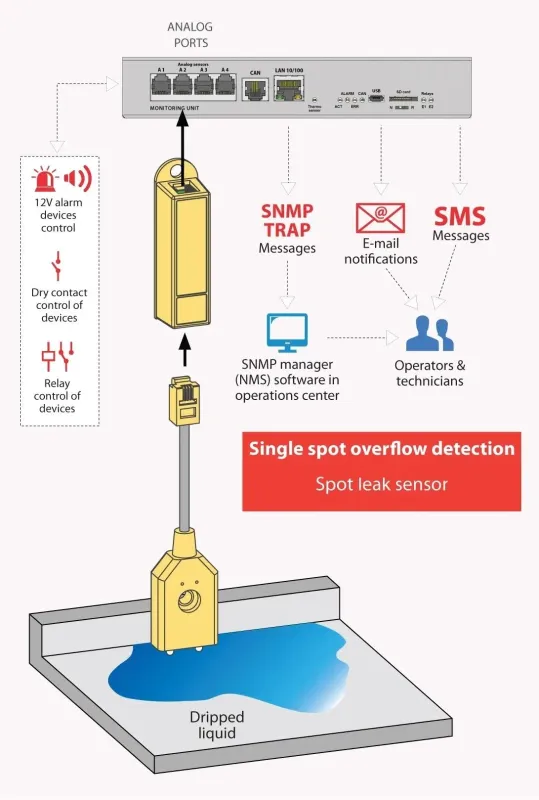
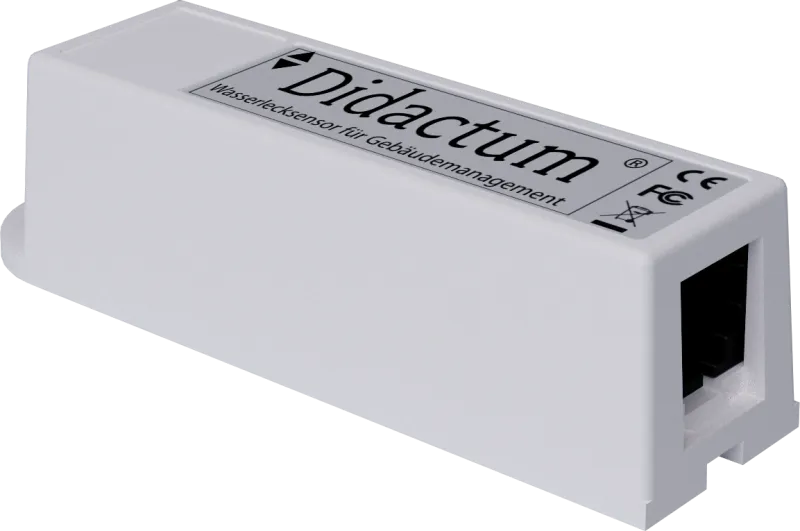
▼The Didactum Water Sensor detects water via capacitive measurement between two metal poles. Unlike conventional metal-based sensors, it is extremely durable thanks to low operating voltages and a corrosion-free measuring principle – ideal for continuous operation in moisture-prone environments.
Compatible with any analog port of the Didactum monitoring unit; scalable via the sensor expansion unit.
 🔍 Enlarge
 🔍 Enlarge
| Area | Use Case |
|---|---|
| Data centers | Leak detection under raised floors or next to critical IT infrastructure |
| Industry | Monitoring under machines, boilers, or piping systems |
| Residential & commercial | Kitchen, bathroom, washing machine, dishwasher, boiler room |
| Level detection | Detecting whether water has reached a defined level in a container |
 🔍 Enlarge
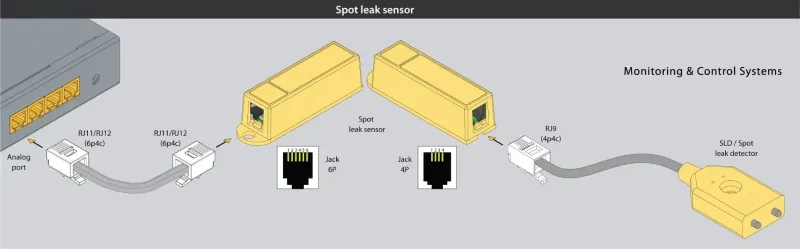
- Plug the Didactum Water Sensor into a free analog port of the monitoring unit via the RJ11/RJ12 6P4C cable (plug-and-play).
- Connect the Spot Leak Sensor (SLD) to the Didactum Water Sensor via the RJ 4P2C cable.
Didactum Sensor for Water Detection Chain (BMS)
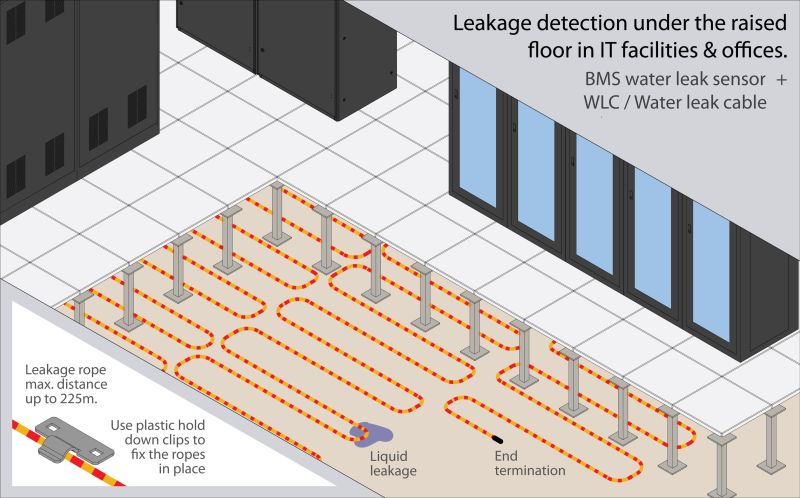
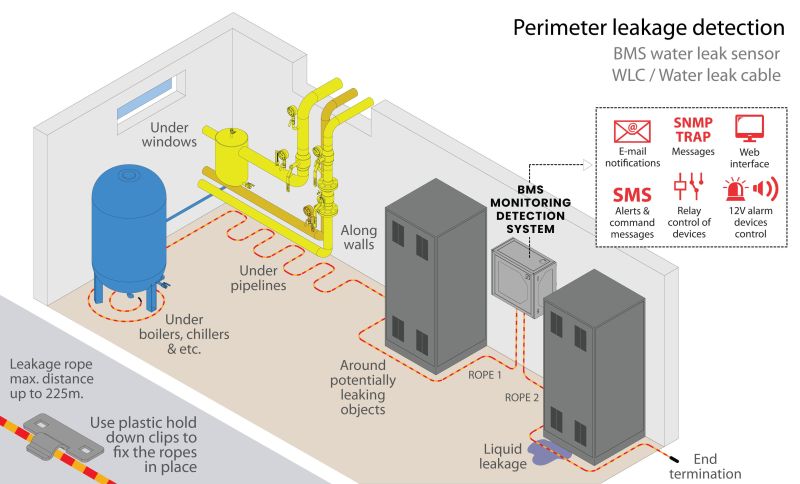
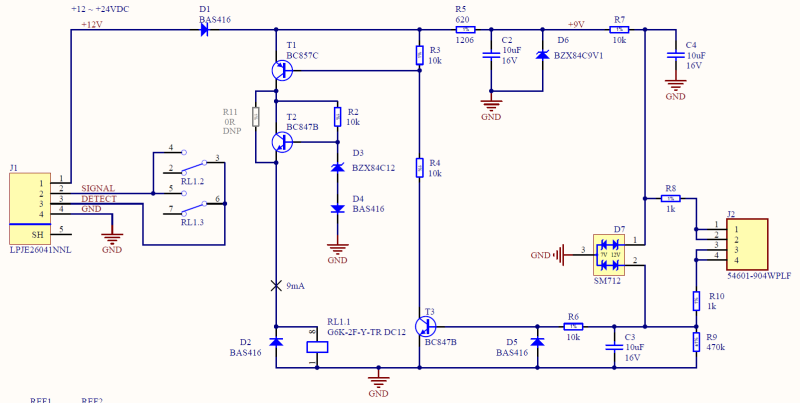
▼The Didactum Sensor for Water Detection Chain (BMS) is designed for integration into building management systems (BMS) and provides continuous leak-warning functionality. It works together with the Didactum Water Chain (WLC), which must be ordered separately.
 🔍 Enlarge
| Model Number | Supply Voltage |
|---|---|
| VT594-12 | 12 V DC |
| VT594-24 | 24 V DC |
 🔍 Enlarge
 🔍 Enlarge
 🔍 Enlarge
- Connect the sensor to the BMS system's dry-contact input, as well as to the power supply (12 V or 24 V DC) and ground.
- Attach the terminal adapter cable to the sensor.
- Connect the Didactum Water Chain (WLC) to the terminal adapter cable.
- Connect additional WLC segments in series as a chain, if needed.
- Lay the water chain around risk areas or under the raised floor.
- Seal the last WLC connector with the supplied protective cap.
- The sensor is now ready for operation.
DIN Rail AC Voltage Sensor
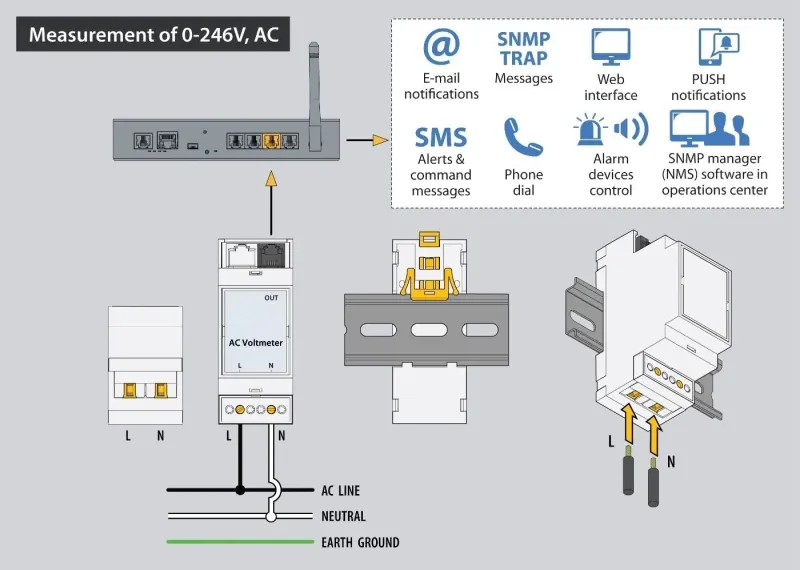
▼The DIN Rail AC Voltage Sensor enables real-time monitoring of mains AC voltage and protects critical infrastructure through early detection of voltage fluctuations and power anomalies. It measures AC voltage in the range of 0–246 V and is available with interchangeable plug types for Europe, the USA, Australia/China, South Africa, and the United Kingdom.
Plug-and-play – connects to any analog port (A1…A8) of the Didactum monitoring unit and is detected automatically.
 🔍 Enlarge
 🔍 Enlarge
Didactum Dust Particle Sensor
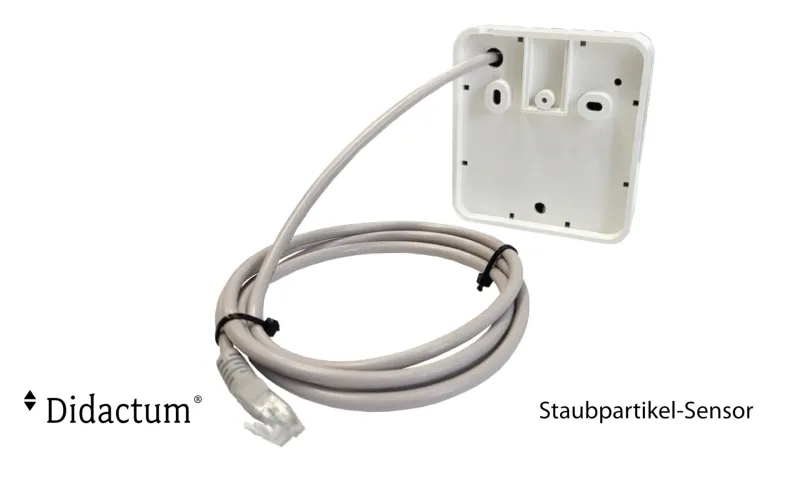
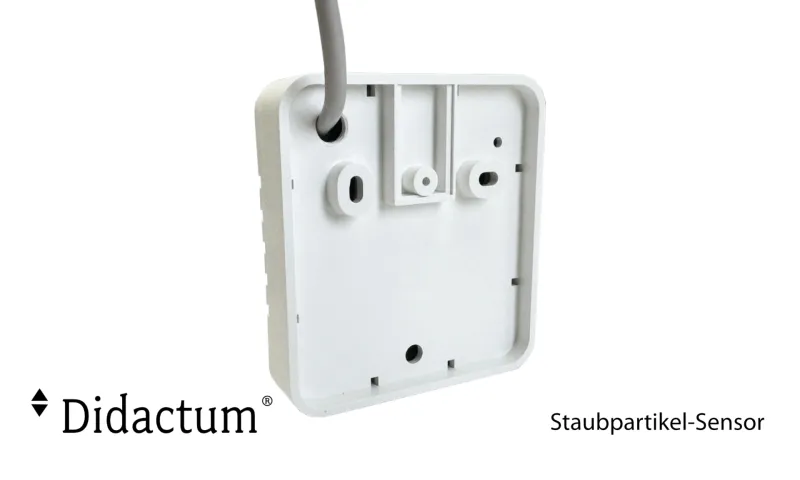
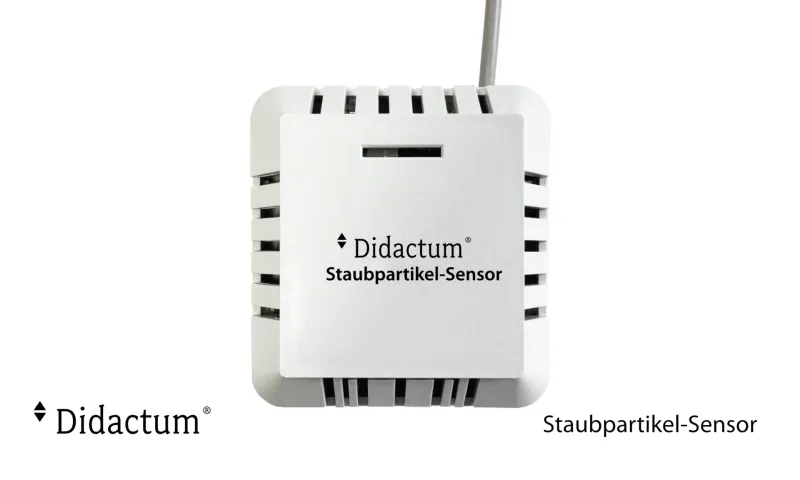
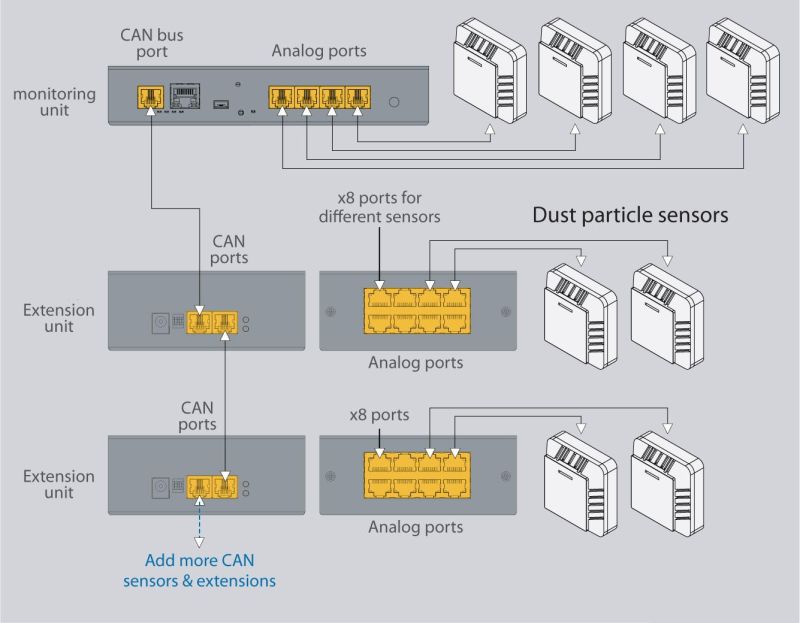
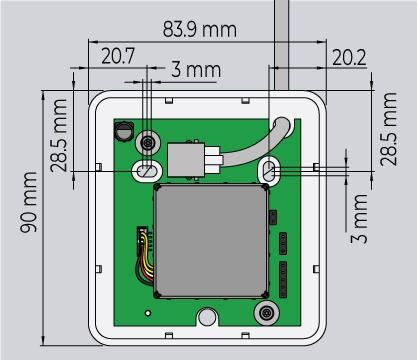
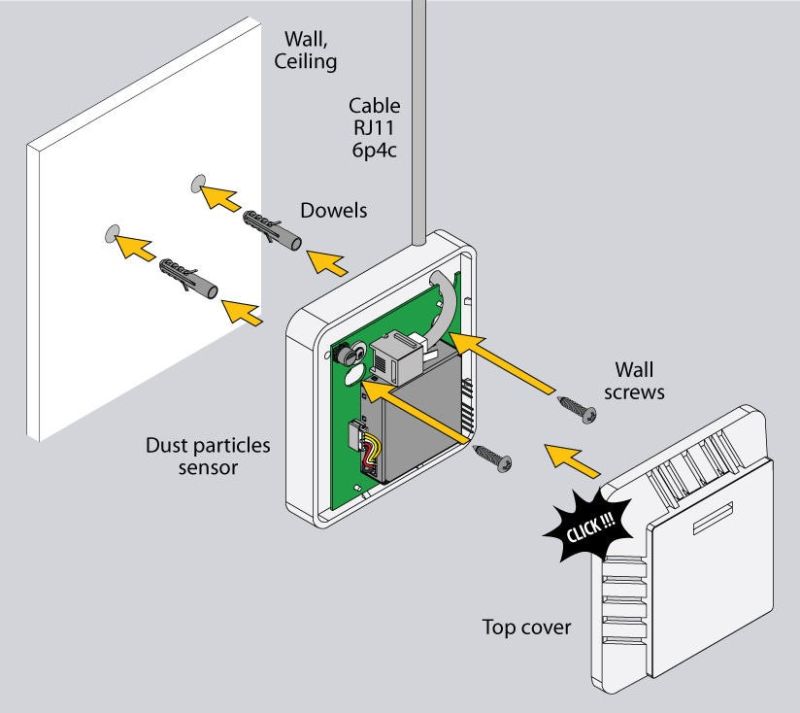
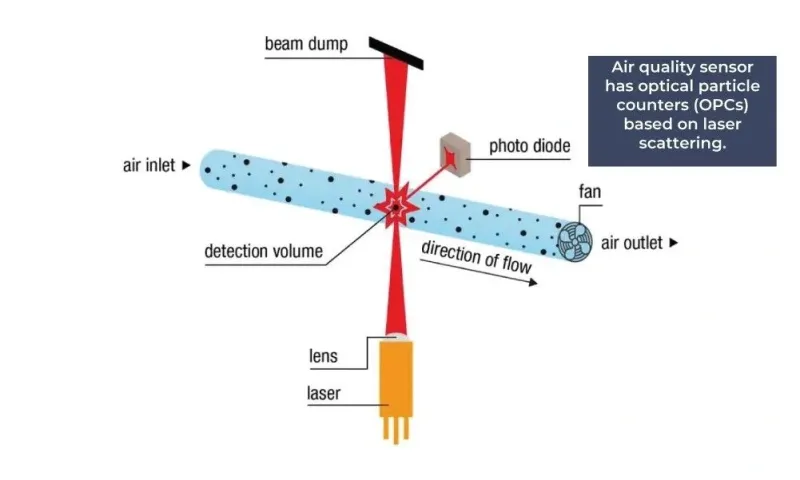
▼The Didactum Dust Particle Sensor monitors air quality and fine particulate levels in real time. Its measuring principle is based on laser scattering with innovative contamination-protection technology, delivering precise readings from initial commissioning up to a service life of over ten years.
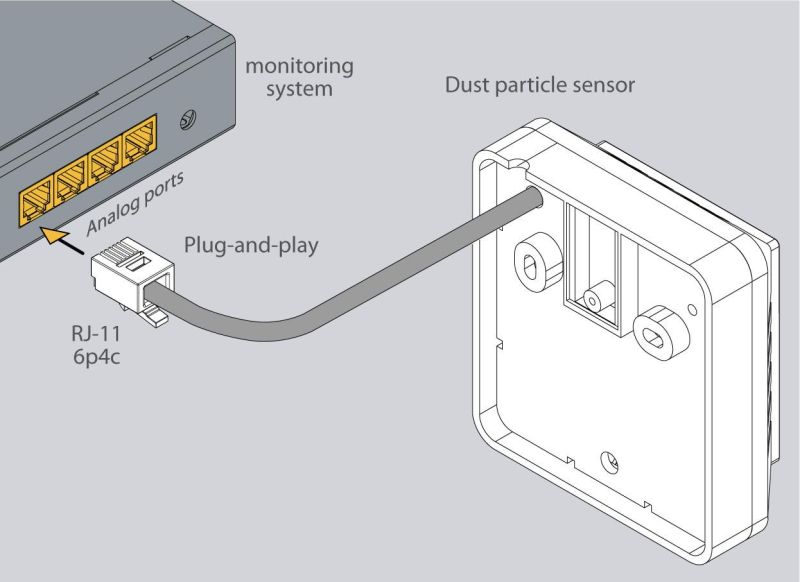
Analog plug-and-play sensor; can be connected to any analog port (A1…A8) of the Didactum monitoring unit. Supports event triggering via logic schemes.
 🔍 Enlarge
 🔍 Enlarge
 🔍 Enlarge
 🔍 Enlarge
 🔍 Enlarge
 🔍 Enlarge
 🔍 Enlarge
 🔍 Enlarge
 🔍 Enlarge
Didactum DC Voltage Sensor
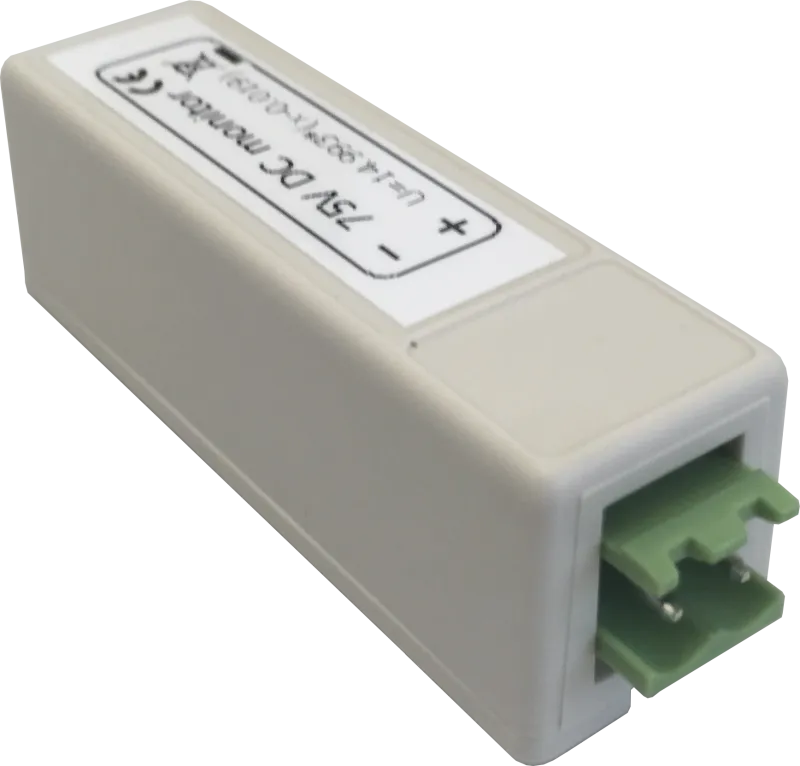
▼The Didactum DC Voltage Sensor measures DC voltages and converts the data into a format compatible with the Didactum monitoring systems. It enables real-time remote monitoring of DC voltages – ideal for data centers, industrial automation, battery systems, and photovoltaic systems.
Plug-and-play, connects to any analog port of the Didactum monitoring unit. Scalable with the sensor expansion unit.
 🔍 Enlarge
 🔍 Enlarge
| Model | Measuring Range |
|---|---|
| VT410 4V | 0 – 4 V DC |
| VT410 5V | 0 – 5 V DC |
| VT410 10V | 0 – 10 V DC |
| VT410 15V | 0 – 15 V DC |
| VT410 75V | 0 – 75 V DC (particularly suitable for low voltages) |
Example 1 – Battery monitoring: The DC voltage sensor is excellently suited for monitoring battery voltages in UPS systems. The sensing wires are connected directly to the positive and negative terminals of the battery. Voltage drops indicating declining battery capacity are detected early and trigger an alarm.
Example 2 – 48 V DC circuits: 48 V DC supply circuits are widely used in telecommunications facilities and data centers. With the VT410 75V model, the voltage of such circuits can be permanently monitored. If configured threshold values are exceeded or not reached, the Didactum monitoring unit automatically triggers alarms or performs pre-configured actions.